No. Lock weekly snapshots first, then layer AI forecasting on a cadence you already trust. Forecasting encodes who submits, how often, and against which quota. Fix capture and measurement before you flip the model on.
I'm Michael Thomas Zajac, a sales operator in Hermosa Beach. I have spent about 20 years carrying the number and building the systems under the reps, and I would rather have a boring, locked forecast cadence than a shiny AI forecast on incomplete activity.
What did the industry just say about AI forecasting rollout?
On September 18, 2026, Philipp Stelzer at Weflow published How to roll out Revenue AI software in phases. The core argument is capture-first: activity and contact capture first, conversation intelligence next, pipeline intelligence after that, and forecasting last.
Forecasting goes last because it is a process and cadence decision, not a feature flip. You are encoding who submits, how often, at deal or manager level, against which quota and which budget. That needs sales leadership in the room, not just RevOps.
Weflow CEO Janis Zech put the failure mode plainly. Teams that ask for forecast accuracy often find missing data and missing visibility underneath. Fix the root cause first. Forecasting first only fits if activity data in Salesforce is already complete and a forecast cadence already exists. If either is false, the model inherits whatever capture missed.
I am not pitching Weflow here. I am nodding at the sequence, because it matches what broke (and what worked) when I ran forecast measurement for real.
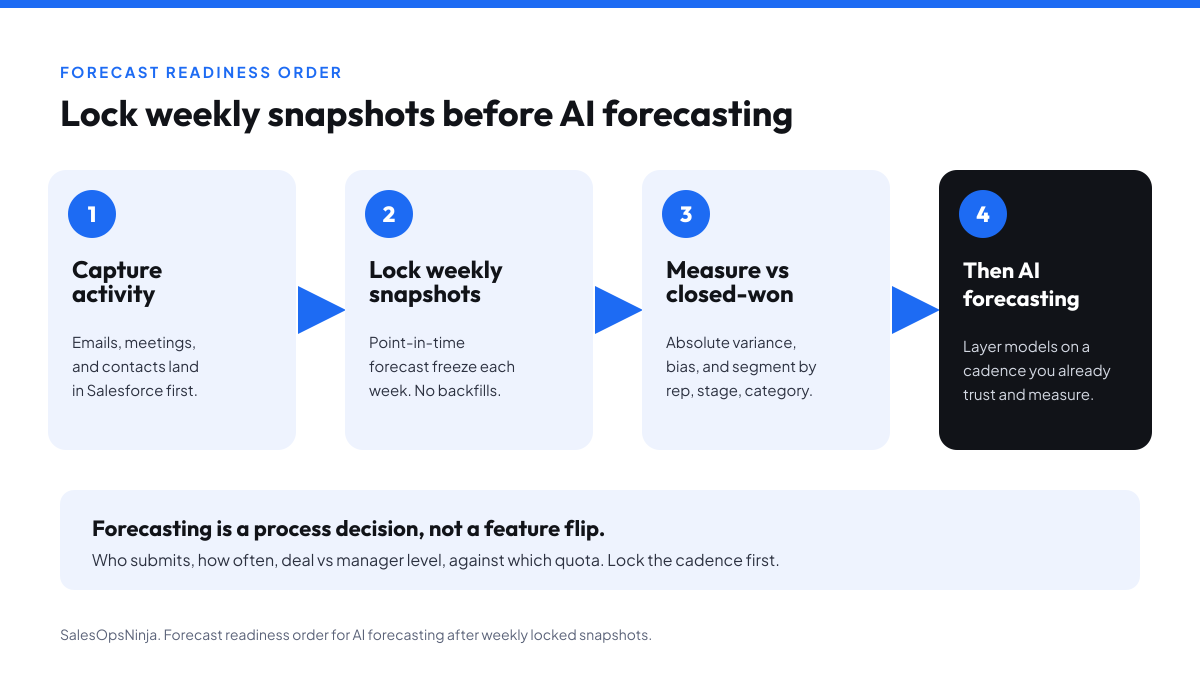
The order of operations: capture, lock weekly snapshots, measure vs closed-won, then AI forecasting.
What was actually broken?
Not the algorithm. The algos were never the first problem. The hard part was proving what leadership believed last Tuesday against what closed this quarter.
Most teams run a live forecast that moves every time a rep edits a close date. There is no point-in-time freeze. Accuracy becomes a story told after the fact, with soft memories and soft spreadsheets. Directional bias stays invisible. Nobody can segment misses by rep, segment, stage, forecast category, or snapshot week, because there is no immutable snapshot week to segment.
Then an AI forecasting tool shows up and gets pointed at that moving target. The model looks smart in the demo. In production it amplifies whatever the CRM failed to capture and whatever cadence leadership never locked.
What did I build instead?
On a Fortune 500 consulting engagement (NDA), I rebuilt forecast measurement around weekly locked point-in-time snapshots.
Every week the forecast froze. No backfills. No quiet edits after the lock. When the quarter closed, we compared each locked snapshot to eventual closed-won bookings using absolute variance. We measured accuracy and directional bias. We segmented by rep, segment, stage, forecast category, and snapshot week so the misses had owners and patterns, not vibes.
That cadence is the boring foundation AI forecasting needs. Models need a ground truth. Weekly locked snapshots are that ground truth.
What number did locking produce?
Forecast accuracy moved from 65% to 94% on that consulting engagement. Same methodology: absolute variance between the weekly locked snapshots and eventual closed-won bookings, with bias and segment cuts alongside the headline accuracy.
I will not hang that number on Intertrust. At Intertrust, where I ran sales ops and BD for 17 salespeople across four continents, the forecast story was different and approximate (roughly 50% into the low-90% range). Keep those separate. The canon STAR for this post is the Fortune 500 consulting lift: 65% to 94%.
If your CRM records are still a mess before any of this, clean and score first. I walked through that order in Would you rather have perfect CRM data or the best AI sales assistant?.
When does AI forecasting go first?
Almost never. The honest exception matches the Weflow framing: activity data in Salesforce is already complete, and a forecast cadence already exists. You are replacing the collection tool, not inventing the process. If either condition is false, lock snapshots and measure first.
What should you do Monday?
Here is the Monday checklist:
- Freeze one weekly snapshot this week. Pick a day and time. Export or store the point-in-time forecast. No edits after the lock.
- Name the cadence in writing. Who submits, how often, deal vs manager level, against which quota or budget. Get sales leadership in that room.
- Define accuracy as absolute variance vs closed-won. When the period closes, compare each locked snapshot to bookings. Track directional bias too.
- Segment the misses. Rep, segment, stage, forecast category, snapshot week. Patterns beat anecdotes.
- Fix capture gaps before you buy the model. Missing activity and missing visibility are forecast problems wearing a different hat.
- Only then layer AI forecasting. Point the model at a cadence you already trust and can score.
Lock the snapshots. Then let the AI earn its seat.